
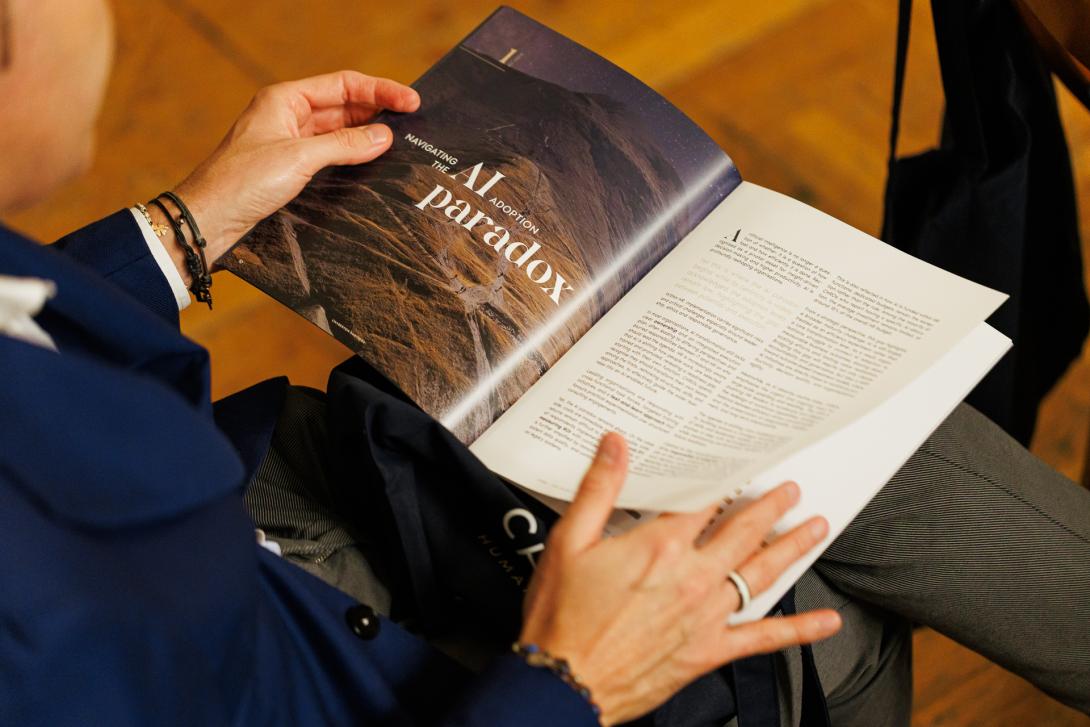
AI and Human Capital: Chaberton Partners Presents Its Research at Caffè Pedrocchi
Source: PadovaOggi – Padua, 27 October 2026
“CHRO Report 2026” puts AI, resilience and company culture at the centre. A roundtable featuring HR leaders from Bauli Group, OVS, Swegon Group and the University of Padua, from 5:30 pm to 8:00 pm.
“CHRO – The Orchestrator of the Adaptive Organisation” is the new research report by Chaberton Partners, a European executive search firm with 14 offices across the continent. The study is based on more than 100 qualitative interviews with HR leaders from medium-sized and large companies operating in six European countries (Austria, France, Germany, Italy, Spain and Switzerland), with 93% of company headquarters located in Europe.
The research identifies three main areas reshaping the role and responsibilities of the HR function:
- the gap between ambition and reality in the adoption of artificial intelligence;
- the growing need to build resilient organisations capable of withstanding continuous shocks;
- the strengthening of company culture as a strategic lever in a multigenerational workforce.
The “CHRO Report 2026” event at Caffè Pedrocchi
The research findings will be at the centre of the “CHRO Report 2026 – Leadership and Human Capital in an Era of Change” event, scheduled for Tuesday, 27 October, from 5:30 pm to 8:00 pm at Caffè Pedrocchi in Padua.
During the roundtable, moderated by Barbara Targa, Partner at Chaberton Partners, the study’s main findings will be discussed with:
- Massimo Bottacin, Chief People Officer at Bauli Group;
- Gian Luca Dellepiane, Chief Human Resources at OVS;
- Libera Anna Insalata, HR Director at Swegon Group;
- Tommaso Meacci, HR Director at the University of Padua.
The event will conclude with keynote speeches by Fabio Di Giammarco, CEO of Bauli Group, and Christian Vasino, CEO and Founder of Chaberton Partners.
Artificial intelligence: high ambitions, limited measurement
AI is widely recognised as a strategic priority, yet the gap between stated intentions and actual implementation remains significant. Only 29% of companies consider themselves ready to transition to AI-enabled working models, and just 8% have introduced KPIs capable of reliably measuring the economic return.
In HR functions with a dedicated AI budget, the average allocation is around 15% of total resources. This suggests that technology is still being treated more as an experimental project than as a structural driver of transformation. The main barriers to scaling up are not financial resources, but fragmented responsibilities, often divided between HR and IT, and a shortage of internal skills.
The HR processes receiving the greatest technological investment are recruitment and selection, workforce planning and predictive analytics, and personalised training. At the same time, CHROs and HR leaders identify inconsistent data quality, dependence on legacy systems and cultural resistance to change as the main obstacles.
Geopolitics and resilience: disruption has become the norm
Among the HR leaders interviewed, 67% report that their companies have been directly affected by geopolitical factors, including tariffs and trade barriers, tensions in Asian markets, supply-chain pressures and revenue losses in strategic areas, regardless of company size or industry.
This figure highlights how HR now sits at the centre of high-impact decisions involving workforce relocations, rapid reorganisations and business continuity. In this context, HR leaders are expected to develop capabilities that, until a few years ago, were primarily associated with other functions: a solid understanding of economics and finance, the ability to interpret geopolitical developments, and proficiency in using data to make faster, better-informed decisions.
Culture and generations: five generations, one organisation
Over the next decade, for the first time in history, up to five generations, from Baby Boomers to Generation Alpha, will work alongside one another in the same organisations, bringing significantly different values, expectations and working styles.
Managing this generational diversity is no longer simply a matter of workplace climate; it is a competitive factor. Companies that design environments in which every generation feels recognised while sharing a common purpose and ways of working can build an advantage that is difficult to replicate.
New skills for new scenarios
When it comes to training investment priorities, CHROs identify two parallel needs. On the one hand, companies must strengthen technical skills — AI literacy, cybersecurity and data analytics — across the workforce. On the other, human skills are being reassessed and gaining importance, including critical thinking, emotional intelligence and the ability to work in highly uncertain environments.
In a context where technical knowledge quickly loses value, the ability to learn, adapt and collaborate becomes the hardest skill to replace.
Chaberton Partners
Chaberton Partners is a leading European executive search and board advisory firm, founded in Lugano in 2017. It identifies leadership profiles that enable client companies to excel in a constantly evolving global market. Already present in six countries (Austria, France, Germany, Italy, Spain and Switzerland), the firm has ambitious plans for further expansion and combines the standards of an international organisation with the tailored approach of a boutique. It operates across all market sectors, from consumer goods to financial and professional services, life sciences, industry and technology.