
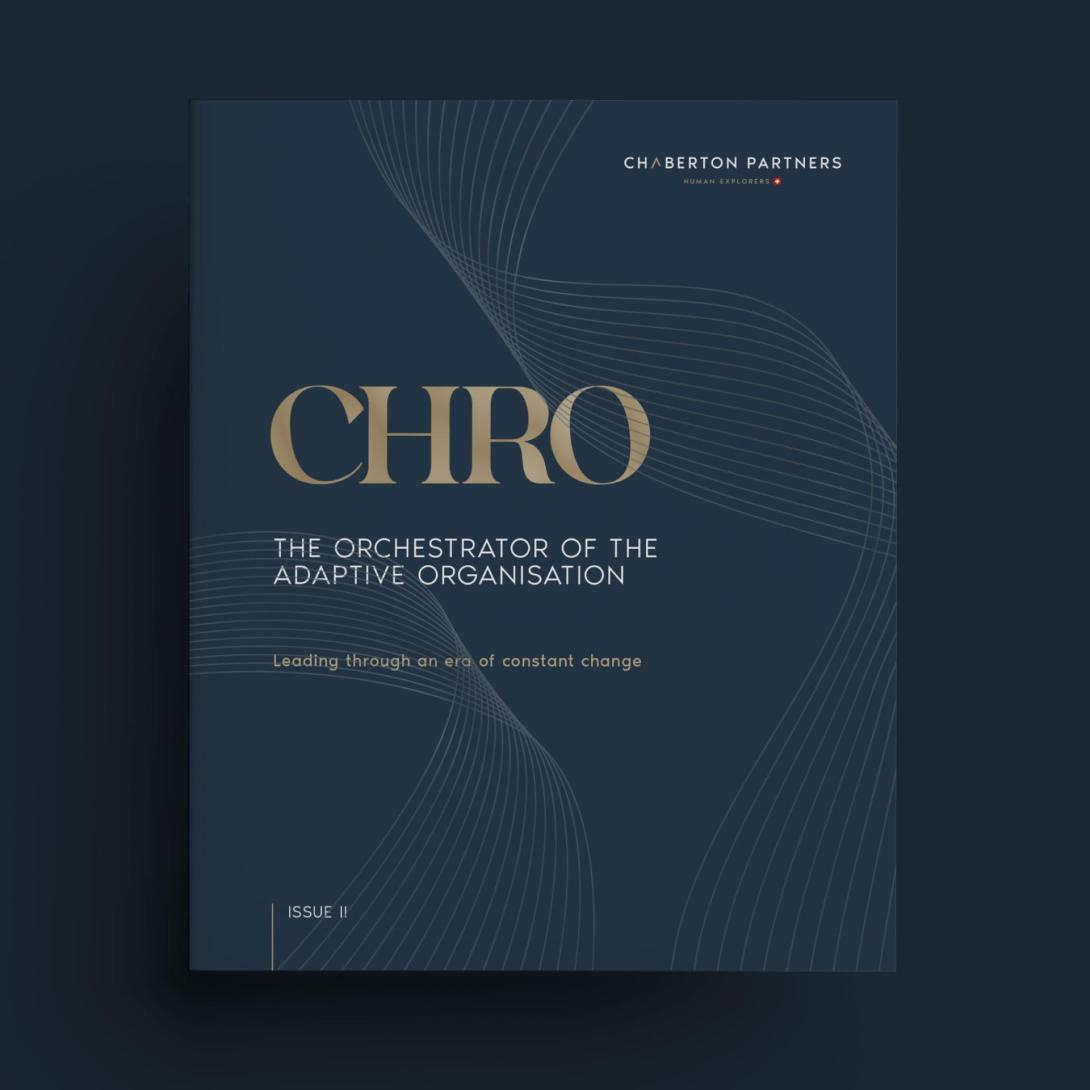
New edition of the CHRO Report 2026
The AI paradox: European companies recognise it as a priority, yet only 29% feel ready
Only 8% of companies actually measure the return on their AI investments. 67% of organisations have already experienced direct impacts from geopolitical factors.
Chaberton Partners’ research, presented in Milan and Geneva, offers a snapshot of the priorities, tensions and challenges reshaping European companies, based on the perspectives of their Chief Human Resources Officers.
Milan, 27 April 2026 – CHRO | The Orchestrator of the Adaptive Organisation, presented yesterday in Milan following a preview held a few days earlier in Geneva, is the latest tresearch report by Chaberton Partners, a European executive search firm with 14 offices across the continent.
The study is based on more than one hundred qualitative interviews with HR leaders from medium and large companies operating in six European countries — Austria, France, Germany, Italy, Spain and Switzerland — with 93% of headquarters located in Europe. The research identifies three key trends reshaping the role and responsibilities of the HR function: the gap between ambition and reality in the adoption of artificial intelligence; the growing need to build resilient organisations capable of facing continuous shocks; and the strengthening of corporate culture as a strategic lever in an increasingly multigenerational workplacee.
Artificial intelligence: high ambitions, limited ability to measure impact
AI is widely recognised as a strategic priority, yet the gap between stated intentions and concrete execution remains significant. Only 29% of companies consider themselves ready to transition to AI-enabled wyas of working, while just 8% have introduced KPIs capable of reliably measuring its economic return. Among HR functions with a dedicated AI budget, the average allocation stands at around 15% of overall resources: a sign that the technology is still treated more as an experimental project than as a core driver of transformation.
What is preventing companies from scaling up is not a lack of financial resources, but the fragmentation of responsibilities — often split or disputed between HR and IT — and the shortage of internal skills. The HR processes most affected by technology are recruitment and selection, workforce planning and predictive analytics, and personalised training. At the same time, CHROs and HR leaders identify uneven data quality, dependence on legacy systems and cultural resistance to change as the main obstacles.
"It is a paradox that recurs across many organisations: AI is recognised as a priority, investment costs are immediately visible, while the benefits remain difficult to measure in concrete use cases. This is often compounded by a lack of clear ownership across HR, IT and the business."
notes Christian Vasino, Founder and CEO of Chaberton Partners.
"The real shift will come when companies move from an experimental mindset to an investment approach focused on outcomes."
Geopolitics and resilience: discontinuity has become the new normal
67% of the HR leaders interviewed state that their company has been directly affected by geopolitical factors — tariffs and trade barriers, tensions in Asian markets, pressure on supply chains, revenue losses in strategic regions — regardless of company size or sector. This figure shows how much the HR function is now at the centre of high-impact decisions: workforce relocations, rapid reorganisations and the safeguarding of business continuity.
In this context, HR leaders are called upon to consolidate skills that, until a few years ago, were the preserve of other functions: strong business and financial acumen, the ability to interpret geopolitical scenarios, and the ability to use date to make faster, better-informed decisions.
Culture and Generations: Five Generations, One Workplace
Over the next decade, for the first time in history, up to five generations — from Baby Boomers to Generation Alpha — will work simultaneously within the same organisations, bringing markedly different values, expectations and working styles. Managing this generational diversity is no longer merely a matter of workplace climate: it is a competitive factor. Companies capable of designing environments in which each generation feels recognised, while sharing a common purpose and operating model, build an advantage that is difficult to replicate.
New skills for new scenarios
When it comes to investment priorities in training, CHROs point to a dual imperative. On the one hand, the need to strengthen technical skills — AI literacy, cybersecurity, data analytics — across the entire workforce. On the other, a renewed appreciation of human skills: critical thinking, emotional intelligence and the ability to work in highly uncertain environments. In a context where technical knowledge becomes obsolete quickly, the ability to learn, adapt and collaborate becomes the hardest skill to replace.
About Chaberton Partners – Executive Search
Chaberton Partners is a leading Executive Search and Board Advisory firm in Europe. Founded in Lugano in 2017, the firm is committed to identifying leadership profiles that enable its client companies to excel in a constantly evolving global market. Already present in six countries (Austria, France, Germany, Italy, Spain, and Switzerland), Chaberton Partners has ambitious plans for further expansion and combines the standards of an international firm with the tailored approach of a boutique. It operates across all market sectors, ranging from consumer goods to financial and professional services, life sciences, industry and technology.
Media Relations
Micol Scabbia
Group CMO, Chaberton Partners